
The difference between a prepared survivor and a desperate victim is often a single, non-functioning piece of gear or a single, blocked route. In any high-stakes scenario—be it a remote camping trip, a financial crisis, or a security incident—relying on a single system or plan is a fatal vulnerability.
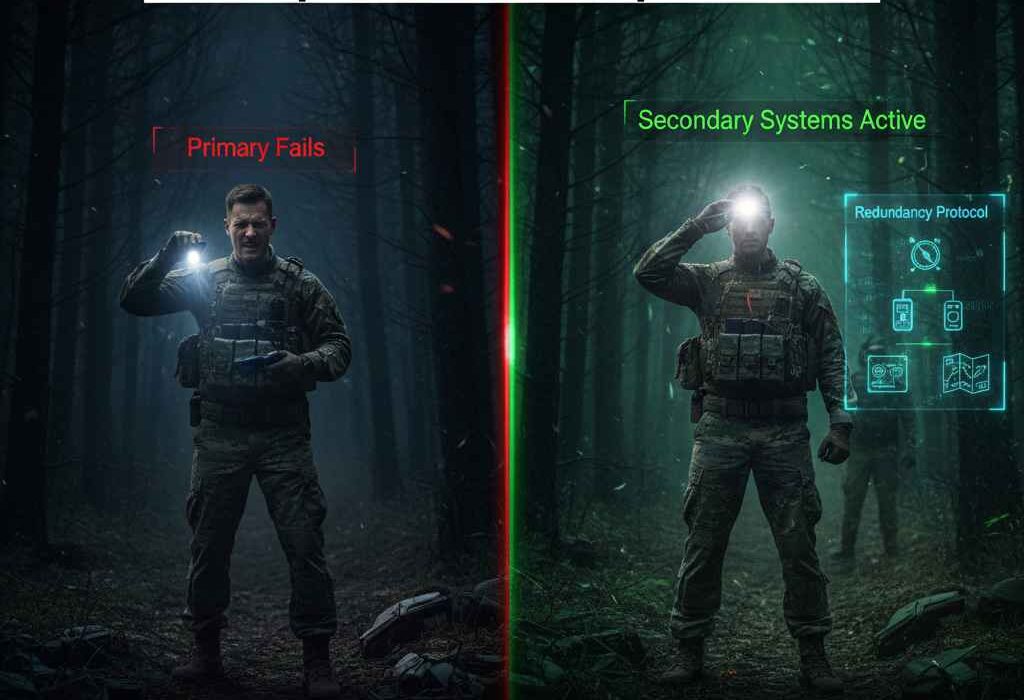
Tactical Redundancy is the strategic acknowledgement that your primary system will fail. It demands that every critical function be supported by independent, secondary, and tertiary methods. This mindset eliminates panic and keeps you operational when others are paralyzed by failure.
1. 🔑 The 1 is 0, 2 is 1 Principle
This is the golden rule of redundancy:
- 1 is 0: If you only have one of something critical (one knife, one map, one escape route), you effectively have zero, because its guaranteed failure will leave you stranded.
- 2 is 1: If you have two of something critical, you have one functional asset—the one you are currently using—and one backup ready for when the first fails.
2. 🔥 Redundancy in Core Survival Functions (The Big 4)
In survival, you must apply redundancy to the four critical needs: Fire, Water, Navigation, and Light.
| Core Function | Primary System | Secondary System (Different Mechanism) | Tertiary System (Passive/Natural) |
| Fire | Butane Lighter (Convenience) | Ferro Rod/Striker (Durability, Reliability) | Fresnel Lens/Friction Bow Drill (Passive/Primitive) |
| Water | Bottled Water (Sealed Source) | Water Filter (Mechanical Purification) | Chemical Purification Tablets/Boiling (Thermal/Chemical) |
| Navigation | GPS/Phone App (Speed/Detail) | Laminated Paper Map & Compass (No Battery) | Celestial Navigation/Terrain Association (Natural) |
| Light | Headlamp (Hands-Free) | Keychain Flashlight (Always Accessible) | Chemical Light Sticks (Extended, Low Light, No Battery) |
Crucial Note: Redundancy is not having three lighters. It is having a lighter, a ferro rod, and a bow drill. If your first system is compromised (e.g., wet), your backups must rely on a different, independent mechanism to function.
3. 🗺️ Redundancy in Planning and Movement
This principle moves beyond gear and applies to your strategy, especially during high-stress scenarios like Exfiltration (Exfil).
A. Communication Redundancy
- Primary: Cell phone/Satellite Communicator.
- Secondary: Two-way radio (walkie-talkie) or coded signals (whistle).
- Tertiary: A written communication plan pre-shared with a trusted contact who initiates rescue if a check-in is missed.
B. Exit Route Redundancy
- Primary Route: Fastest and most direct path (high probability of being blocked or congested).
- Secondary Route: Utilizes concealment (back alleys, tree lines, ditches) to reduce visibility.
- Tertiary Route: Utilizes terrain obstacles (rivers, steep climbs) that are too difficult for casual pursuit but passable for you. Never rely on one way out.
C. Personal Gear Redundancy (The “Distributed Load”)
Instead of storing all key items in one pack:
- Level 1 (Pocket): Knife, small light, wallet, tiny water purification tablets (immediate grab-and-go).
- Level 2 (Daypack): Primary water, fire, medical kit, communication.
- Level 3 (Stashed Cache): Stored food, heavy shelter, fuel in a secure, static location.

4. 🧠 Redundancy in the Mindset
The ultimate form of redundancy is psychological.
- Failure Drill: Before executing any critical step, quickly visualize its failure. What if the fire doesn’t light? What if the river crossing is too deep? By mentally rehearsing the failure, you pre-load the backup plan, reducing the shock and delay when the failure inevitably occurs.
- Emotional Resilience: Recognize that anger, frustration, and panic are massive energy drains and delay tactics. When a system fails, the prepared mindset is simply: “System 1 failed. Switch to System 2.”
Tactical redundancy is the ultimate form of self-insurance. It is the acknowledgement that preparedness is not about preventing problems, but about ensuring that when problems arrive, you have the independent tools and strategies to pivot and survive.