
🌊 Rivers: Lifeline or Barrier?
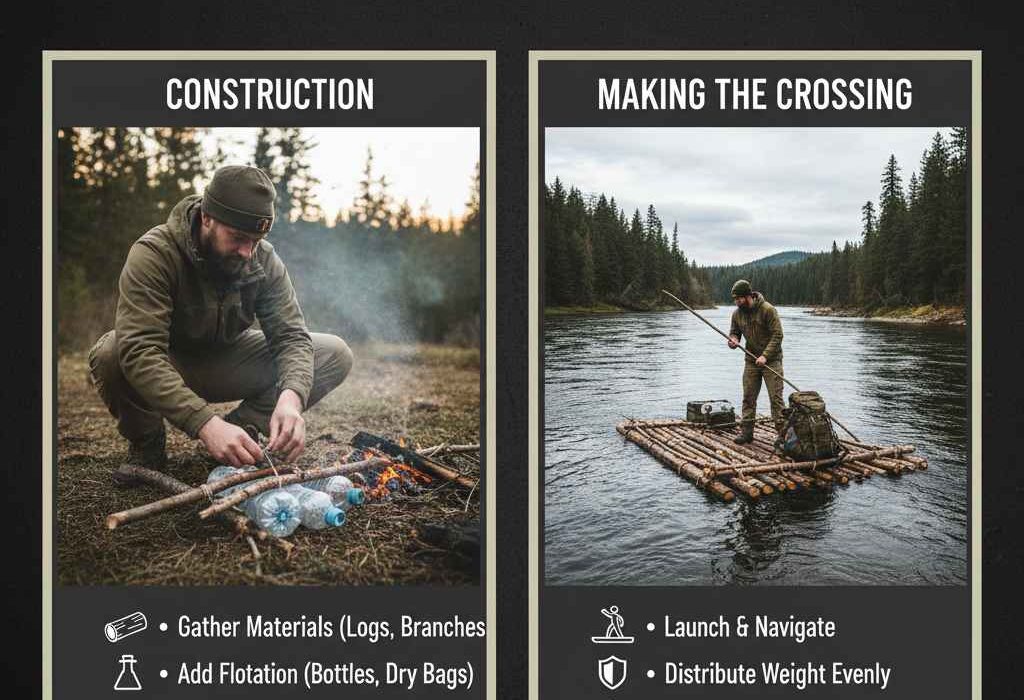
In survival scenarios, rivers can both save you and trap you. They provide water, fish, and travel routes, but they can also block your path when you need to move fast. If you’re stranded with no bridge in sight, building an improvised raft might be your only way across. The key is balancing floatation, stability, and safety with the materials around you.
🌲 Choosing Materials for Floatation
Your raft is only as good as what keeps it afloat. Look for:
- Logs or branches – Dry, lightweight woods like cedar, pine, or birch float best.
- Driftwood – Already water-tested and often lighter.
- Plastic containers or barrels – If luck is on your side, sealed containers can act as excellent pontoons.
- Bamboo – Strong, buoyant, and naturally hollow.
Tip: Freshly cut green wood is heavy and sinks—use dry wood whenever possible.
🪢 Binding the Raft Together
Even the best logs won’t help if they scatter mid-river. Secure them with:
- Paracord or rope (if you have it).
- Vines or inner bark fibers (nature’s rope).
- Cloth strips or belts in emergencies.
Cross-lash the bindings in a crisscross pattern for maximum strength. The tighter, the better—loose knots can mean disaster in strong currents.
🛶 Building a Basic Raft
- Lay logs side by side to form the base.
- Add crossbeams on top to hold them together.
- Layer smaller branches to create a stable surface.
- Double up flotation if carrying gear or more than one person.
Optional: Add a paddle carved from wood or a pole for pushing in shallow water.
⚠️ Safety First: Know the Risks
Crossing rivers is risky, even with a raft. Always check:
- Current speed – Avoid areas with strong rapids.
- Depth – Shallow waters are easier to pole through.
- Debris – Floating logs or rocks can capsize your raft.
- Entry & exit points – Choose calm banks for launch and landing.
And remember: Never tie yourself to the raft. If it flips, you need to swim free.
🔑 Final Thought
An improvised raft isn’t a luxury—it’s a survival solution when no bridge or boat exists. With the right wood, strong bindings, and smart planning, you can turn nature into your lifeline.
👉 In survival, adaptation is your best tool—sometimes, that means building your own way across.