
Blending in isn’t about wearing green and hoping for the best. Camouflage and concealment are practical skills built on observation, preparation, and disciplined movement. Whether you’re hunting, doing recon, or simply trying to go unnoticed in an urban or wilderness environment, knowing how to disappear into background noise and shapes can keep you safe and effective.
This guide breaks down the principles, gear choices, movement, environment matching, and drills so your concealment becomes intentional — not accidental.
Why Camouflage & Concealment Matter
- Avoid detection: The primary goal is to prevent visual identification.
- Gain time: Remaining unseen gives you options: observe, evade, or reposition.
- Force multiplier: Proper concealment reduces the need for confrontation.
- Adaptive: Works in wilderness, urban, and mixed environments.
Camouflage is clothing and pattern. Concealment is the full package — posture, movement, silhouette, and environment manipulation.
Core Principles (The Foundation)
- Match Color & Tone — Your colors should match the dominant tones of the environment (not just “green” vs “brown”).
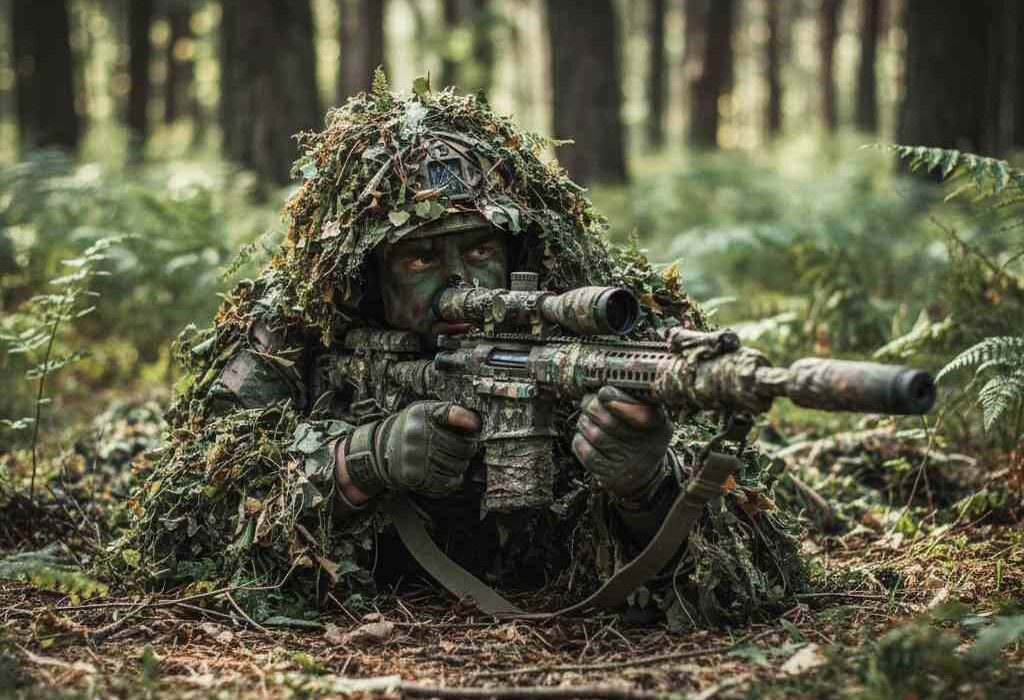
- Break the Outline — Shapes identify humans; disrupt that outline with natural materials, pattern, and irregular edges.
- Avoid Shiny & Moving Parts — Metal, wet fabric, and reflective surfaces draw the eye.
- Control Contrast — High-contrast items (bright logos, light shirts) are immediate giveaways. Tone down contrast to blend.
- Move Like the Background — Motion attracts attention. When you must move, move slowly and deliberately in short bursts.
- Use Depth & Shadow — Position yourself in shadows or behind texture to hide. Don’t sit on the skyline.
Clothing & Pattern: Pick Smart, Not Fashionable
- Pattern choice matters: Multi-scale disruptive patterns (digi, multicam variants) work best across mixed terrain. Solid colors fail more often.
- Consider season & region: Greens for spring/summer; tans and browns for fall; grays and muted colors for urban settings.
- Layer & texture: Break up uniform flat fabric by adding netting, foliage, or irregular materials. Texture helps dissolve a silhouette.
- Avoid perfect matches: Too-perfect camo can create recognizable uniform shapes. Slight mismatches and added natural elements are more convincing.
- Non-reflective fabrics: Matte finishes cut glare. Treat or choose gear that doesn’t shine when wet.
Face, Hands & Exposed Skin — The Weak Links
- Face paint / camo cream: Use in blotches, not full masks. Paint in dark-light-dark patterns across forehead, cheeks, and chin to break facial geometry.
- Gloves & sleeves: Cover hands and wrists; exposed skin is high-contrast and often the first thing noticed.
- Eye protection: Matte frames or covered goggles prevent small reflections.
- Avoid perfume & scented soaps: Odor can betray you to animals and attentive humans. Use unscented products before deployments.
Silhouette Management — Break the Human Shape
- Lower profile: Crouch, kneel, or use prone position when possible. Tall profiles are easier to spot.
- Use natural breaks: Sit behind logs, rocks, or depressions so your outline merges with terrain.
- Add irregular elements: Dead leaves, brush, or loose fabric make the shape less human. Don’t glue bright items to yourself—keep colors natural.
- Avoid skyline positions: Never sit on ridgelines or top of walls where you’re outlined against the sky.
Movement: How to Move Without Being Spotted
- Slow & deliberate: Short, slow steps with pauses — scan between moves.
- Snap movements: Move only while others are distracted, or during ambient noise events (wind gusts, vehicles).
- Bounding vs. continuous: In exposed terrain, use short bounds from cover to cover rather than continuous walking.
- Use shadows & texture: Move through shadow bands and behind textured backgrounds to mask motion.
- Feet-first exit: When quickly leaving a concealed position, move feet first into the new cover to minimize silhouette exposure.
Environment Matching: Know Your Ground
- Scout before settling: Walk the area to note dominant colors, light angles, and human paths.
- Seasonal change: What worked in July won’t in November. Update gear and disguise accordingly.
- Urban concealment: Use trash, parked cars, signage, and building blind spots. Avoid reflective surfaces and bright signage.
- Wet/dry differences: Wet foliage darkens; soil color changes—test visual matches when possible.
Deception & Decoys: Create Confusion
- Use distractions: Noise, brief lights, or movement in another sector can draw attention away from your position.
- Dummy signatures: Toss a jacket or leaves to create a false signature if you need to mislead pursuers. Use sparingly and strategically.
- Scent masking: In wilderness, keep food away and downwind. In urban settings, don’t touch areas people will closely inspect (door handles, clear paths).
Tools & Gear That Help
- Ghillie additions: Lightweight ghillie strips or netting can break outline—use only after testing for snagging and overheating.
- Face mesh & veils: Low-visibility nets for face concealment in dusty/leafy environments.
- Noise-dampening boots & soft soles: Reduce footprint and sound.
- Non-reflective tape: Matte tape for metal gear, optics, or zipper pulls.
- Compact pruning tools: For local foliage additions—don’t destroy protected plants; use fallen material.
Detection Avoidance: What Observers Look For
- Movement: The single biggest giveaway — even subtle motion catches the eye.
- Edges & contrast: Hard lines, shapes, and contrasts are recognized instantly.
- Patterns out of place: A bit of foliage in your hand reveals you more than a full ghillie does wrong.
- Silhouettes at skyline: If your top breaks the horizon, you’re visible.
- Reflections: Metal, wet fabric, or sunglasses are immediate attractors.
Training Drills to Improve Concealment
- Blend & Hold Drill: Find a spot, match it visually, and hold position while a partner slowly approaches—evaluate detection distance and posture.
- Movement Intervals: Move between two points using bounds; partner watches for movement detection—work to increase distance before detection.
- Face/Hand Check: Practice wiping or applying basic face paint under time limit and low light.
- Silhouette Reduction: Use a camera or phones with zoom to test how you appear at range—adjust gear until you disappear.
- Urban Hide Drill: Use cars, signage, and building alcoves in a parking lot to practice urban concealment and quick exits.
Train regularly and critique honestly — small errors compound at distance.
Ethical & Legal Considerations
- Don’t trespass or break laws to practice concealment. Use private property or approved ranges.
- Respect wildlife & protected areas—don’t remove living plants or harm habitats for ghillie material. Use fallen debris.
- Public safety: Concealment in public spaces can alarm others or be misinterpreted. Avoid suspicious behavior—practice responsibly.
- If armed, know the rules of engagement & local law about concealment and use of force.
Frequently Asked Questions (Quick Hits)
- Q: Is ghillie gear always best?
A: No — ghillie stands out if misused. Use it selectively in heavy foliage; in mixed terrain, light disruptive patterns + natural material work better. - Q: How long before my camouflage is effective?
A: It depends on training and environment. With practice, you’ll learn to reduce detection distance significantly within weeks. - Q: Can you hide from thermal/IR sensors?
A: Thermal concealment is advanced. Minimize heat signature with insulating layers and by not exposing hot surfaces; total concealment requires specialized equipment and tactics.
Key Takeaway
Camouflage and concealment are an interplay of observation, gear, and movement. It’s less about matching a pattern and more about disrupting what makes you look human: your outline, motion, and contrast. Master the basics—match tone, break outline, move like the background—and you’ll disappear far more often than you’ll be found.
Blend in. Move slowly. Stay unseen.